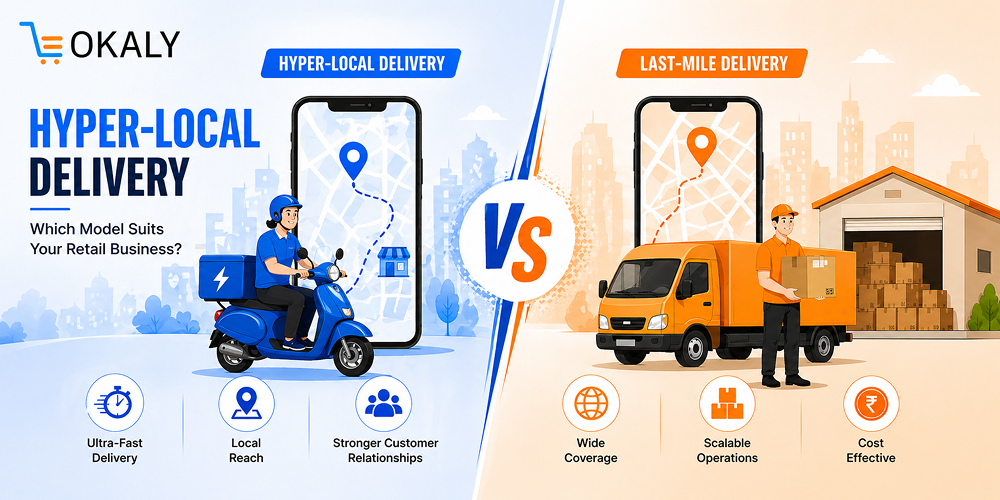
Hyper-Local vs. Last-Mile Delivery: Which Model Suits Your Retail Business?
INTRODUCTION
Picture this. It is 7 PM on a Tuesday. A customer places an order on your store’s app — a bag of groceries, a bottle of medicine, or a pair of running shoes. They want it within the hour. You have the stock. You have the staff. But do you have the right delivery model to make it happen?
This is the question retail business owners across the world are wrestling with right now. It is being asked in neighbourhood grocery shops in London, family-run pharmacies in Toronto, local fashion boutiques in São Paulo, and quick-service restaurants in Singapore. Wherever local commerce exists, this question is relevant.
Two delivery models dominate the conversation: hyper-local delivery and last-mile delivery. Both get products to customers’ doors. Both rely on technology and logistics networks. But they work very differently — and choosing the wrong one for your business could cost you customers, margin, and long-term growth.
This guide breaks down exactly what each model means, how they differ in practice, and which one makes more sense for your retail business today and in the years ahead.
WHAT IS HYPER-LOCAL DELIVERY?
Hyper-local delivery is a logistics model where goods are shipped from a nearby store or fulfilment point — typically within a 1 to 10 kilometre radius — directly to the customer’s door, often within 30 minutes to 2 hours.
The word “hyper-local” is the key. This model is built entirely around proximity. The seller and the buyer are in the same neighbourhood. The product never travels across a city, a state, or a country. It moves just a few streets, which is exactly what makes it fast.
Think of it this way: instead of a warehouse on the outskirts of your city processing thousands of orders a day, hyper-local delivery uses your existing store as the fulfilment hub. A customer nearby places an order. Your team picks and packs it. A delivery partner collects it and drops it off — often before the customer has even had time to second-guess their purchase.
This model has been popularised globally by quick-commerce platforms. Companies like Gorillas and Getir in Europe, GoPuff in the United States, and rapid delivery services across Southeast Asia and the Middle East have demonstrated how powerful neighbourhood-level delivery can be when it is executed well. They use small, strategically placed “dark stores” — mini-warehouses located within residential zones — to promise delivery in under 30 minutes.
But you do not need venture capital funding or a network of dark stores to build a hyper-local delivery operation. Any local retailer — a grocery shop, a pharmacy, a fashion outlet, a restaurant, or a hardware store — can implement this model using the right platform and their existing store infrastructure.
HOW DOES HYPER-LOCAL DELIVERY WORK?
The mechanics are straightforward, and that simplicity is part of what makes the model so accessible for independent retailers.
Step one: A customer browses your store’s online catalogue — on your website, your app, or a local commerce platform like Lokaly — and places an order.
Step two: Your team receives the order notification and begins picking and packing items from existing in-store inventory.
Step three: A delivery partner — your own staff member, a freelance courier, or a rider assigned through your delivery management system — collects the packed order from your shop.
Step four: Using GPS-optimised routing, the rider delivers the order directly to the customer’s address within the same neighbourhood or delivery zone.
Step five: The customer receives a real-time notification when the order is collected and again when it arrives at their door.
The entire journey — from tap to doorstep — is compressed into minutes or hours. That compression is possible because the distance is small and the inventory already exists where the customer needs it.
WHAT IS LAST-MILE DELIVERY?
Last-mile delivery refers to the final leg of a longer, more complex supply chain. On this stage, a parcel moves from a regional distribution centre, warehouse, or logistics hub to the end customer’s address.
The phrase “last mile” originates from the logistics and telecommunications industries, where it describes the most expensive and operationally demanding stretch of any journey. A product might travel thousands of kilometres from a manufacturer to a central warehouse efficiently and cheaply. But that final mile — navigating city traffic to reach a specific door at a specific time — is where costs climb, delays accumulate, and customer satisfaction is most at risk.
Last-mile delivery is what powers the world’s largest e-commerce platforms. When a customer orders from Amazon, Zalando, or a major online marketplace, a third-party logistics provider handles the last-mile leg: collecting parcels from a regional fulfilment centre and distributing them across an entire city or postcode area. Delivery typically takes 1 to 5 business days, depending on the service tier and distance.
The scale of this market tells you how dominant the model is globally. The global last-mile delivery market was valued at over USD 177 billion in 2025 and is projected to exceed USD 453 billion by 2035, growing at a CAGR of 9.8%. That sustained growth reflects how much of global retail is still built around long-supply-chain logistics — and how seriously logistics providers are investing in optimising this final stage.
HYPER-LOCAL VS. LAST-MILE DELIVERY: THE CORE DIFFERENCES
Both models deliver products to customers. But almost everything else about them is different. Here is a direct comparison across the dimensions that matter most to retail business owners.
DELIVERY AREA AND RADIUS
Hyper-local delivery is designed for tight geographic zones — typically 1 to 10 kilometres from the store or fulfilment point. It is built for neighbourhood commerce: the customer and the seller are in the same part of the same city. The shorter the radius, the faster the delivery.
Last-mile delivery operates at a much broader scale. A single last-mile logistics route might cover dozens of neighbourhoods, multiple postcodes, or an entire metropolitan area. The product originates at a warehouse that could be located far from the end customer.
For a retailer whose customers are primarily local — people who live or work near your store — hyper-local delivery is almost always the better structural fit. For a retailer serving customers across an entire country or multiple regions, last-mile delivery becomes necessary.
DELIVERY SPEED
This is where hyper-local delivery wins decisively and consistently. Because the distance is so short, orders can be fulfilled in 30 minutes to 2 hours in a well-run operation. The fastest platforms in the world now deliver within 10 to 20 minutes using micro-fulfilment infrastructure.
Last-mile delivery is inherently slower. Even with same-day delivery options — which many large carriers now offer in major cities — products moving from a centralised warehouse to a customer’s address typically take at least 2 to 4 hours and often 1 to 3 business days for standard services.
Consumer expectations have shifted permanently, and this shift is global. Research consistently shows that more than a quarter of consumers across major markets are willing to pay a premium for faster delivery. In cities where quick-commerce platforms have normalised 30-minute delivery, slower fulfilment is not just a disadvantage — it is a reason to switch to a competitor.
COST STRUCTURE
Hyper-local delivery typically has a lower per-delivery operational cost for the final stage of fulfilment. Short travel distances mean less fuel, less rider time, and more deliveries per hour per rider. A well-optimised hyper-local operation can deliver profitably even at relatively modest order values.
The trade-off is that hyper-local requires local inventory. To fulfil orders quickly, you need your stock positioned close to your customers. If you are scaling across multiple neighbourhoods, that means maintaining well-stocked stores or dark stores across your delivery zones.
Last-mile delivery costs are higher per shipment but are designed to be spread efficiently across long routes. Large logistics operators can optimise costs through route density algorithms, automated sorting facilities, and consolidated bulk handling. For businesses with genuinely national or international reach, last-mile logistics is often more cost-efficient at scale than building a hyper-local network.
For small and independent retail businesses, the honest assessment is this: hyper-local delivery is usually cheaper and more manageable to start with. You use your existing inventory and store infrastructure. You keep control of the process. You are not paying per-shipment rates to a carrier whose performance you cannot directly control.
INFRASTRUCTURE REQUIREMENTS
Hyper-local delivery uses your store as the fulfilment centre. In most cases, the infrastructure is already there: the inventory, the shelving, the staff. The incremental investment is in a digital ordering interface and a delivery management system — tools that platforms like Lokaly provide out of the box.
Last-mile delivery requires either building your own logistics infrastructure — which is expensive, complex, and operationally demanding — or contracting with third-party providers. When you hand delivery over to an external carrier, you lose direct control over the customer experience at the most critical moment: when your product actually arrives.
PRODUCT TYPES
Not every product suits every delivery model, and this is an important practical consideration.
Hyper-local delivery is best suited for perishable goods such as groceries, fresh food, and pharmaceutical products; time-sensitive items where customers need fulfilment now rather than tomorrow; and lightweight to medium-weight products that can be transported efficiently by cycle couriers or motorbike riders.
Last-mile delivery handles a broader product range more effectively — including heavy or bulky items like furniture and large appliances, fashion and electronics requiring careful handling, and high-value products that need signature-confirmed delivery.
CUSTOMER EXPERIENCE
When hyper-local delivery is executed well, it creates a genuinely remarkable customer experience. The customer places an order, receives a confirmation, watches live tracking on a map, and receives their purchase before they have had time to think about anything else. That immediacy builds deep loyalty and drives repeat business.
Last-mile delivery offers broader reach and often more robust handling for complex items. The trade-off is clear: speed and personal connection with hyper-local, versus reach and specialist capability with last-mile.
THE ADVANTAGES OF HYPER-LOCAL DELIVERY FOR RETAIL BUSINESSES
Let us go deeper into why hyper-local delivery is becoming the default choice for small and mid-sized retail businesses across the world.
SPEED CREATES COMPETITIVE ADVANTAGE
The single biggest advantage of hyper-local delivery is what customers value most: speed. In any market where quick-commerce platforms have already reset consumer expectations, a retailer that can offer 30-minute to 2-hour delivery holds a meaningful competitive edge over businesses still running on next-day or 2-to-3-day fulfilment cycles.
For local retailers, this is actually a natural structural advantage — one that has historically been impossible to monetise without the right technology. You already have stock positioned close to your customers. You already know your community. Hyper-local delivery is the digital layer that converts that proximity into a reliable, scalable service.
LOWER ENVIRONMENTAL IMPACT
Hyper-local delivery is significantly more sustainable than traditional last-mile logistics. Short-distance deliveries by cycle couriers, electric bikes, or small electric vehicles consume a fraction of the energy used by large vans and trucks covering extensive urban routes.
As sustainability becomes a genuine purchasing factor — particularly among younger consumers in North America, Europe, and urban Asia — the ability to offer low-emission local delivery is both an ethical advantage and a marketing one. Many retailers are now actively using their hyper-local, low-emission delivery model as a brand differentiator.
STRONGER COMMUNITY CONNECTION
When a customer orders from your neighbourhood store and a familiar face delivers it within the hour, it creates a fundamentally different relationship than a parcel arriving in a generic courier box from a warehouse several cities away.
Hyper-local delivery reinforces the act of buying local — supporting a business in the community — while delivering the digital convenience that modern consumers expect as standard. This combination of community loyalty and digital convenience is extremely powerful. It drives repeat purchases and word-of-mouth referrals that no paid advertising budget can fully replicate.
REAL-TIME INVENTORY ACCURACY
Because hyper-local delivery fulfils orders directly from store inventory, customers see real-time availability. There are no warehouse-to-store lag times, no stock discrepancies between an online catalogue and physical shelves, and no “sorry, this item is actually out of stock” messages after a customer has already placed their order and waited.
What is on the shelf is what is available for delivery — and a good local delivery management system keeps that data accurate and synchronised in real time.
NO DEPENDENCY ON THIRD-PARTY CARRIERS
Every time you hand a customer’s order to a third-party courier, you lose direct control of the experience. Delays, damaged packaging, and impersonal delivery communications all reflect on your brand even when the fault lies entirely with the carrier. Customer service complaints about delivery are typically directed at the retailer, not the logistics company.
Hyper-local delivery keeps you in control from the moment an order is placed to the moment it arrives. Your products. Your delivery standards. Your brand promise.
THE CHALLENGES OF HYPER-LOCAL DELIVERY
Being honest about the difficulties is part of making a genuinely useful guide. Hyper-local delivery is not without operational complexity.
MANAGING OPERATIONS AT SCALE
Running a hyper-local delivery operation — tracking riders in real time, managing live inventory, handling peak-hour order volumes, communicating with customers at every step — requires robust technology. Without the right local delivery management system, operations can unravel quickly during busy periods.
This is precisely the problem that platforms like Lokaly are designed to solve. A centralised dashboard that manages orders, inventory, rider assignment, and customer notifications eliminates the manual bottlenecks that cause mistakes and delays.
LIMITED GEOGRAPHIC REACH BY DESIGN
Hyper-local delivery is built for proximity. If your customers are spread across an entire metropolitan area or beyond, a single-zone hyper-local operation will not reach all of them. Expanding reach means either opening more fulfilment points in additional zones or combining hyper-local delivery for nearby customers with last-mile delivery for those further away.
RIDER SUPPLY AND RELIABILITY
Hyper-local delivery depends on having delivery personnel available when and where orders come in. Peak demand periods — evenings, weekends, public holidays, and promotional sale days — can create situations where demand outpaces rider supply. Building a reliable, responsive delivery team takes consistent management, fair compensation structures, and the flexibility to scale up during busy periods.
THE ADVANTAGES AND CHALLENGES OF LAST-MILE DELIVERY
Last-mile delivery is not the wrong choice — it is simply the right choice for a different set of business circumstances.
WHAT IT DOES WELL
Last-mile delivery gives businesses national and international reach. If your products are in demand across an entire country or multiple markets, last-mile logistics partners enable fulfilment at a scale that no hyper-local network could support alone.
It is also well-suited for specialist delivery requirements: temperature-controlled shipments, large or heavy items, high-value goods requiring proof of delivery, and products that need multi-stage handling through sortation centres.
WHAT MAKES IT DIFFICULT
Last-mile delivery is expensive. According to research consistently cited across the global logistics industry, last-mile logistics can account for 41 to 53% of total supply chain costs. The challenges are well understood: urban traffic congestion slows routes; failed delivery attempts when customers are not home add cost and friction; address errors cause repeated trips; and the reverse logistics cost of managing returns erodes margins further.
For small and independent retailers without the order volume to negotiate competitive per-shipment rates with major carriers, these costs can make last-mile delivery economically punishing — particularly on lower-value orders.
QUICK COMMERCE VS. HYPER-LOCAL DELIVERY: ARE THEY THE SAME THING?
This distinction comes up in conversations about modern retail logistics, and it is worth addressing clearly.
Quick commerce — often called q-commerce — is hyper-local delivery compressed to its most extreme form. Q-commerce platforms promise delivery in 10 to 30 minutes by pre-positioning stock in dark stores located within residential neighbourhoods, supported by AI-driven inventory systems and real-time order routing. Gorillas in Germany, GoPuff in the United States, and several major platforms across Asia and the Middle East operate on this model.
Hyper-local delivery is the broader category. It encompasses q-commerce but is not limited to it. Hyper-local can mean 30-minute delivery or 2-hour delivery. It can use an existing retail store as the fulfilment point rather than a purpose-built dark store. It can serve a single neighbourhood or an entire city zone.
For most independent retailers, true q-commerce infrastructure — multiple dark stores, sophisticated demand forecasting systems, dedicated 10-minute delivery fleets — is neither accessible nor necessary. But hyper-local delivery, using your existing store as the fulfilment hub and a platform like Lokaly to manage the end-to-end process, is very much achievable regardless of the size or stage of your business.
The global q-commerce market is expanding rapidly, growing at a rate that is reshaping consumer expectations across categories and geographies. This creates a genuine opportunity for local retailers who are willing to adopt the same speed-first, proximity-first mindset — without needing to replicate the full infrastructure of a funded platform.
WHICH DELIVERY MODEL IS RIGHT FOR YOUR RETAIL BUSINESS?
There is no single correct answer. The right model depends on your business type, your customer geography, your product mix, and your existing operational infrastructure. The following framework helps you make a decision clearly and practically.
CHOOSE HYPER-LOCAL DELIVERY IF:
Your customers are primarily within a 1 to 10 kilometre radius of your store. This is the most important filter. If your core customer base lives or works near you — people who already know your shop and choose it over national alternatives — hyper-local delivery is built for your situation.
You sell products that benefit from speed. Groceries, medicines, prepared food, cosmetics, daily consumables, electronics accessories, and convenience items all benefit from same-hour delivery. Customers who want these products typically want them now.
You want end-to-end ownership of the customer experience. Hyper-local delivery keeps your brand in direct contact with the customer at every step — from order confirmation to doorstep arrival.
You are a small or medium-sized retailer without the order volume for national logistics partnerships. Hyper-local delivery has a low barrier to entry. You begin with your existing store, existing inventory, and a digital platform to manage orders and delivery.
You want to compete with large online marketplaces on the one dimension they fundamentally cannot match: speed at the neighbourhood level. A national marketplace warehouse cannot deliver to your neighbour’s door in 30 minutes. You can. That is a structural advantage worth building on.
CHOOSE LAST-MILE DELIVERY IF:
Your customer base is distributed across multiple cities, regions, or countries with no concentration near a physical store location. National or international reach requires last-mile logistics infrastructure.
You sell products that require specialist carrier handling — large furniture, heavy appliances, fragile high-value items, or goods requiring a formal signature at the point of delivery.
You are a manufacturer, brand, or wholesale distributor fulfilling large-volume orders from a central warehouse to retail customers across a broad geographic area.
CONSIDER A HYBRID DELIVERY MODEL IF:
You have strong local demand and also serve customers beyond your immediate zone. A growing number of retail businesses find that they need hyper-local delivery for nearby orders and last-mile delivery for everything else — with a unified platform managing both intelligently.
This hybrid approach is increasingly common among multi-location grocery retailers, pharmacy groups, and FMCG distributors that want to serve each customer from the nearest available fulfilment point. The technology to manage this efficiently is no longer reserved for large enterprises.
THE HYPER-LOCAL DELIVERY MARKET: WHY THE WINDOW IS NOW
The market data makes a compelling case for urgency.
Globally, the hyper-local services market was valued at USD 4,025 billion in 2025 and is projected to reach USD 12,546 billion by 2034, representing a CAGR of 13.79%. This is not growth concentrated in one country or one category — it is a global consumer shift toward convenience, proximity, and speed that is reshaping retail logistics on every continent.
The last-mile delivery market, at over USD 177 billion globally in 2025 and growing at 9.8% annually, reflects how much retail still depends on traditional logistics. But within that market, the fastest growth is in hyper-local, quick-commerce, and same-day delivery segments — where consumer demand is most intense.
In North America and Europe, major retailers and logistics operators are actively investing in micro-fulfilment infrastructure, electric delivery fleets, and AI-powered route optimisation to bring delivery times down. In Asia, platforms pioneering 10 to 15-minute delivery have created consumer expectations that are now spreading to other regions.
The businesses capturing local market share in this environment are the ones who recognised that delivery speed is no longer a premium feature — it is a baseline expectation. Every month that a local retailer delays building a hyper-local delivery capability is a month in which a more digitally ready competitor earns that customer’s loyalty instead.
Retailers who act now are building the operational infrastructure, the customer habits, and the brand reputation that will be very difficult for late movers to displace.
HOW LOKALY HELPS RETAIL BUSINESSES LAUNCH AND SCALE HYPER-LOCAL DELIVERY
Lokaly is a commerce platform built specifically for local and regional retail businesses that want to bring their operations digital — without the cost, complexity, or lead time of building everything from the ground up.
The platform gives you everything you need to run a hyper-local delivery operation under one roof, accessible from a single dashboard.
DIGITAL STOREFRONT
Your products are discoverable by customers in your area through a branded digital storefront — not buried under national marketplace algorithm competition. Customers browse your live catalogue, see real-time availability, and place orders directly through the platform.
REAL-TIME INVENTORY MANAGEMENT
Lokaly keeps your online catalogue synchronised with your in-store stock in real time. Automatic low-stock alerts prevent overselling. Customers see accurate availability before they order, which eliminates the disappointment of post-order cancellations.
INTEGRATED DELIVERY MANAGEMENT SYSTEM
The platform assigns incoming orders to available riders, optimises routes using live mapping, and provides full real-time tracking visibility to both you and your customers. Every delivery is managed, monitored, and measurable.
FLEXIBLE PAYMENT SUPPORT
Lokaly supports cash on delivery, digital wallets, card payments, and credit account billing — so your customers can pay using whichever method works for them. This flexibility removes friction from the purchase process and increases order completion rates.
CUSTOMER LOYALTY AND OFFERS
Built-in loyalty tools let you run reward programmes, issue discount vouchers, and create personalised promotional campaigns for your most regular customers. Retention is far more cost-effective than acquisition — and Lokaly gives you the tools to do it properly.
DIGITAL LEDGER AND ACCOUNT MANAGEMENT
For businesses that operate credit accounts with regular customers or wholesale buyers, Lokaly’s digital ledger replaces manual record-keeping with an automatic, always-accurate transaction log accessible from any device.
Whether you run a single neighbourhood grocery shop or a multi-outlet distribution business, Lokaly’s platform is built to grow with you — from your first hyper-local delivery to a full multi-zone retail operation.
FINAL THOUGHTS: DELIVERY IS A BRAND DECISION, NOT JUST A LOGISTICS ONE
There was a time when delivery was a back-office function — something organised after the customer had already committed to buy. That era is over.
Today, delivery speed, reliability, and transparency influence purchasing decisions before a customer even adds an item to their basket. Shoppers evaluate “how fast can I get this?” alongside “how much does it cost?” and “do I trust this seller?” The delivery model you choose communicates something direct and important about your brand: whether you prioritise your customer’s time, whether you are genuinely local, and whether you have invested in the experience you promise.
For most local and regional retail businesses, hyper-local delivery is not just the right logistical choice — it is the right strategic one. It lets you compete with large online marketplaces on the one dimension where you hold a natural structural advantage: you are already close to your customer. You know your community. Your stock is already nearby.
The gap between a great product and a loyal customer is often nothing more than a seamless, fast, reliable delivery experience. Hyper-local delivery, powered by the right platform, closes that gap.
Lokaly exists to make that possible for every retailer — regardless of size, location, or technical background.